


The third session of the Russell Tribunal on Palestine recently convened in Cape Town, South Africa. Its perhaps most controversial finding was that Israel applies a system of apartheid to the entire Palestinian people, including its own citizens. What is the significance of this finding, and what does it mean for civil society in Palestine and the Diaspora – and for Israel and its supporters? In this policy brief, Al-Shabaka Program Director Victor Kattan describes what apartheid means under international law, highlights the Tribunal’s findings, and explains its significance.
Overview
Critics of Israel’s treatment of the Palestinians frequently use the term apartheid—Afrikaans for “apartness.” But is there any merit to the claim that Israel is practicing apartheid against the Palestinian people or is the word without substance and purely provocative? The third session of the Russell Tribunal on Palestine recently convened in Cape Town, South Africa to consider this question. Why did Israel’s defenders react so strongly against the Tribunal – a people’s initiative without power in state relations – going so far as to hack its website, but then remain silent after its conclusions were issued? Can the Tribunal’s conclusion that Israel applies a system of apartheid to the entire Palestinian people, including its own citizens, stand up to scrutiny? What is the significance of this finding, and what does it mean for civil society in Palestine and in the Diaspora – and for Israel and its supporters? In this policy brief, Al-Shabaka Program Director Victor Kattan describes what apartheid means under international law, highlights the tribunal’s findings, and explains its significance.
The Russell Tribunal on Palestine
The original Russell Tribunal was founded in 1966 by the British aristocrat and philosopher Sir Bertrand Russell to inform and mobilise public opinion against U.S. involvement in the Vietnam War. A second Russell Tribunal was convened on Latin America that focused on human rights violations in Argentina, Brazil, and Chile.
The Russell Tribunal on Palestine (RToP) was established in 2009, just after Israel’s offensive in the Gaza Strip during Operation Cast Lead, when over 1,400 Palestinians were killed in what the UN Fact-Finding Mission called “a deliberately disproportionate attack designed to punish, humiliate and terrorize a civilian population.”1 The RToP’s founders, a large group of citizens involved in the promotion of peace and justice in the Middle East, were also concerned that the international community had failed to implement the International Court of Justice’s 2004 Advisory Opinion on the construction of a wall in the occupied Palestinian territory.2
The RToP is not to be confused with a court of law. It is a tribunal of the people. Nonetheless, its proceedings are similar to the preliminary stages of the inquisitorial model of criminal procedure whereby an examining judge actively investigates an accusation to determine whether there is substance to it, before considering whether it merits a trial.3
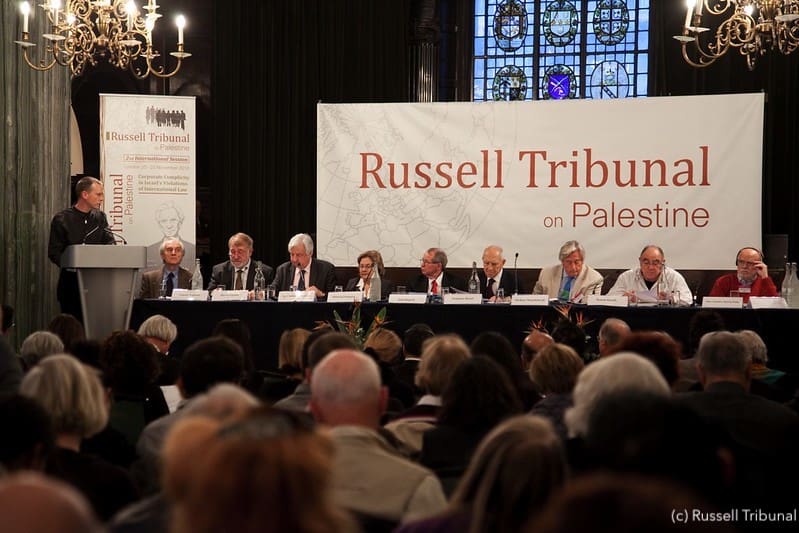
The jury that gathered in Cape Town for the RToP’s third session from 5 – 7 November 2011 included Stéphane Hessel, a Holocaust survivor, and former French diplomat, who helped draft the Universal Declaration of Human Rights, and Ronnie Kasrils, a Jewish member of the African National Congress, who later became a member of the post-apartheid South African government.4 Mairead Maguire, recipient of the Nobel Peace Prize for her work in Northern Ireland, Alice Walker, the African-American author of the Pulitzer Prize winning novel The Color Purple, Cynthia McKinney, a former U.S. Congresswoman who was the first African-American woman to have represented the state of Georgia in the U.S. House of Representatives, and Yasmin Sooka, a member of South Africa’s Truth and Reconciliation Commission were also on the jury, along with British barrister Michael Mansfield QC and Antonio Martin Pallin, a former Spanish Supreme Court judge. The jury was tasked with assessing whether Israel’s practices against the Palestinian people is in breach of the prohibition of apartheid under international law. The decision to host the Tribunal in the District Six Museum was highly symbolic, as it commemorates the destruction and forced relocation of Cape Town’s multi-cultural District Six community by the apartheid government in the 1970s.
Archbishop Desmond Tutu officially opened the Tribunal with an inaugural address. The 25 witnesses called to appear before the RToP were all experts in their fields. They submitted written statements, which the jury was able to examine beforehand, and during the Tribunal’s public sessions, the experts were asked to give presentations, and in some cases had to answer questions posed to them from the jury.
The Israeli Government was invited to present its case before the tribunal but it chose not to exercise this right and provided no answer to correspondence from the RToP. That fact that Israel did not present its case does not invalidate the findings of the Tribunal as the jury was able to take into account the Israeli government’s position from material which is available to the general public, as well as from the reaction of the South African Zionist Federation.
What is Apartheid?
Apartheid is commonly associated with the system of overt racial discrimination that existed in South Africa between the years 1948 and 1994 and in South-West Africa (Namibia) between 1948 and 1990. A similar system of discrimination existed in Rhodesia (today’s Zimbabwe) between 1965 and 1979. That apartheid was a system of government that was not unique to South Africa explains why the Convention for the Suppression and Punishment of the Crime of Apartheid (the 1973 Apartheid Convention) defines apartheid as a crime, “which shall include similar policies and practices of racial segregation and discrimination as practised in southern Africa.” The fact that apartheid existed in southern Africa in the 1970s did not mean that it could not be replicated elsewhere. This was understood by those who drafted that Convention.5
Apartheid is defined by the 1973 Apartheid Convention as “inhuman acts committed for the purpose of establishing and maintaining domination by one racial group of persons over any other racial group of persons and systematically oppressing them.” A similar definition of apartheid is found in the Rome Statute of the International Criminal Court. The prohibition of apartheid applies to any situation where (1) two distinct racial groups can be identified; (2) “inhuman acts” are committed against the subordinate group; and (3) such acts are committed systematically in the context of an institutionalised regime of domination by one group over the other.
Expert testimony submitted to the Tribunal attested to the fact that perceptions of Israeli Jewish identity and Palestinian identity illustrate that Israeli Jews and Palestinian Arabs can readily be defined as distinct racial groups for the purposes of international law. In this connection, the RToP considered that all Palestinians, those in Israel, those in the occupied territories, and the refugees, formed a collective part of the Palestinian people, and were therefore taken into account in its assessment of whether Israel’s practices against the Palestinian people breached the prohibition of apartheid under international law.
Under international law, the practice of apartheid is considered a serious breach of an international obligation as well as an international crime. The crime of apartheid flows from the international criminal law, and the prohibition of apartheid practices come from human rights law, and specifically those treaties that prohibit racial discrimination.
The Tribunal’s Findings
The RToP concluded that “Israel subjects the Palestinian people to an institutionalized regime of domination amounting to apartheid as defined under international law.” It explained that:
This discriminatory regime manifests in varying intensity and forms against different categories of Palestinians depending on their location. The Palestinians living under colonial military rule in the Occupied Palestinian Territory are subject to a particularly aggravated form of apartheid. Palestinian citizens of Israel, while entitled to vote, are not part of the Jewish nation as defined by Israeli law and are therefore excluded from the benefits of Jewish nationality and subject to systematic discrimination across the broad spectrum of recognised human rights. Irrespective of such differences, the Tribunal concludes that Israel’s rule over the Palestinian people, wherever they reside, collectively amounts to a single integrated regime of apartheid.
The conclusion that Israel’s policies towards the Palestinian people collectively amounts to a single integrated regime of apartheid irrespective of where they live, and subject only to the intensity in which apartheid is practiced towards specific categories of Palestinians, is probably the most controversial aspect of the RToP’s findings. Previous studies of apartheid, for instance, have only considered Israel’s regime in the occupied Palestinian territory.6 One explanation as to why previous studies have not examined whether apartheid exists within Israel might have been because it was thought that the case against Israel would be weaker. This is because a distinctive feature of South African apartheid was the denial of the franchise to Africans, whereas in Israel, the Palestinian minority is not denied the right to vote or form political parties.
However, in order to satisfy the provisions of the 1973 Apartheid Convention it is not necessary to show that South African apartheid is being replicated in exactly the same way elsewhere. Indeed, the Apartheid Convention does not even reference restricting the right to vote in the broad list of examples of apartheid that are explicitly mentioned in Article 2 of the 1973 Apartheid Convention. Admittedly, this may have been due to ideological differences, as a free and fair vote was not something common to Communist countries, who were instrumental in challenging apartheid and colonialism, and who paved the way for adoption of the 1973 Apartheid Convention.
It is, however, also possible that the drafters of the Convention may have been of the opinion that denying Africans the franchise was only one aspect, and not even the most important aspect, of the many legislative measures, “calculated to prevent a racial group or groups from participation in the political, social, economic and cultural life of the country” (See Article II, c, 1973 Apartheid Convention). In Rhodesia, for instance, Africans could vote, but only on a separate roll, which limited the number of representatives they could elect to the parliament, which meant they were never in a position to challenge the laws and policies of the white minority.7 A similar argument could be levelled against Israel. Whilst Palestinians can vote and form political parties in Israel their activities are circumscribed by the condition that Israel is a Jewish state and the Palestinian electorate and their representatives in the Knesset (the Hebrew word for Israel’s Parliament) have no chance of changing that.
Another common feature of apartheid as it was practiced in southern Africa was minority rule. In Rhodesia, a mere 3 percent of the population ruled over the remaining 97 percent of the population. The former was white, whilst the latter was black. Similarly, in South Africa, the 20 percent of the population that was white ruled over the remaining 80 percent of the population that was black. Critics of the comparison between Israel and South Africa usually point to the fact that Palestinians in Israel are a minority. Within the 1967 lines, the Palestinian population of Israel is only some 22 per cent. The weakness of this argument stems from the fact that the 1973 Apartheid Convention says nothing about minority rule. In any event, the Palestinian population under Israeli control, including those in the occupied Palestinian territories, is much larger. Moreover, once the Palestinian refugees and those that were displaced in 1948 and 1967 are factored into the equation, then the comparison with southern Africa becomes more evident.
The sensitivity of using the word apartheid
Critics of describing Israel’s policies toward the Palestinians as apartheid are sensitive because apartheid is universally acknowledged to amount to a crime against humanity.8 There are serious consequences for those who participate in such a crime. This might explain why prior to the RToP, Justice Richard Goldstone published a New York Times op-ed arguing that it was wrong to use the word apartheid in relation to Israel because “Israeli Arabs — 20 percent of Israel’s population — vote, have political parties and representatives in the Knesset and occupy positions of acclaim, including on its Supreme Court.”9 What Justice Goldstone does not address are the myriad of issues associated with Israel’s discriminatory practices towards its Palestinian citizens in many other spheres of public life, such as restricting their access to residency rights, land ownership, urban planning, access to services, and social, economic, and cultural rights.
As the RToP observed, “in the Israeli legal system, preferential status is afforded to Jews over non-Jews through its laws on citizenship and Jewish nationality, the latter of which has created a group privileged in most spheres of public life.” As regards the West Bank, the RToP expressed its concern about the institutionalised separation and discrimination revealed by the existence of two entirely separate legal systems, “Palestinians are subject to military law enforced by military courts that fall far short of international fair trial standards; Israeli Jews living in illegal settlements are subject to Israeli civil law and a civil court system. The result is a vastly different procedure and sentence for the same crime, committed in the same jurisdiction, by members of a different group.”
It is worth noting that the extent of Israel’s apartheid practices is deliberately obscured. In contrast to the explicit and readily available South African apartheid legislation, in Israel many of the laws are inaccessible. For instance, military orders are rarely published, and all legislation is published in Hebrew. Whilst it is to be expected that Israeli legislation should be published in Hebrew, which is the language spoken by its Jewish, but not its Arab inhabitants, it makes it very difficult for non-Hebrew readers to understand it.10 In South Africa the discrimination was blatant and was published not only in Afrikaans, but in English, the lingua franca, which meant that it could be readily understood in the West.
Also worthy of note is the complaint filed, while the RToP was underway, by Knesset member Otniel Schneller of the “centrist” Kadima party to the Knesset Ethics Committee, calling on it to revoke the Israeli citizenship of Haneen Zoabi, a Palestinian member of Israel’s Knesset, who was one of the witnesses who testified before the RToP. Schneller told The Jerusalem Post that she wished to expel Zoabi from the Knesset, as well as Balad Knesset member Jamal Zahalka, a fellow Palestinian parliamentarian, because of a trip they had both made to Turkey, and because of Zoabi’s presence before the RToP. “They should go to the Gazan parliament, where they belong,” Schneller told The Jerusalem Post, after she had referred to them as a “fifth column, enemies of the state acting from within.”11
Article II (f) of the 1973 Apartheid Convention stipulates that “persecution of organizations and persons, by depriving them of fundamental rights and freedoms, because they oppose apartheid” can in itself constitute apartheid.
The significance of a finding of apartheid
Prior to the RToP meeting in Cape Town, there was a flurry of critical reports in the media, including Goldstone’s polemic in The New York Times, street protests, a copy cat website, and finally the hacking of the official RToP website just before its findings were released. It may be questioned whether any of these actions served Israel’s interests, as all they achieved was to draw more attention to the RToP and Israel’s practices of apartheid than it would otherwise have received in the international press. In South Africa, the RToP saturated the local papers; op-eds were frequent, and there were several feature length articles. All of South Africa’s major newspapers covered the press conference when Michael Mansfield QC read out the RToP’s findings. One major paper even devoted a section of its front page to the RToP. Compared to the media coverage of previous sessions of the RToP, this one was a great success.
One of the intriguing aspects of the RToP has been the silence from Israel and its supporters since its findings were published. This is probably deliberate as it is likely that Israel does not want to draw attention to the RToP’s recommendations. These included a call on states “to exert sufficient pressure on Israel, including the imposition of sanctions, the severing of diplomatic relations collectively through international organisations, or in the absence of consensus, individually by breaking bilateral relations with Israel.”
The RToP also called on global civil society “to replicate the spirit of solidarity that contributed to the end of apartheid in South Africa, including by making national parliaments aware of the findings of this Tribunal and supporting the campaign for Boycott, Divestment and Sanctions (BDS).” One of the RToP’s recommendations was to call on “the UN General Assembly to reconstitute the UN Special Committee against Apartheid, and to convene a special session to consider the question of apartheid against the Palestinian people.” In this connection it called on the Committee to “compile a list of individuals, organisations, banks, companies, corporations, charities, and any other private or public bodies which assist Israel’s apartheid regime with a view to taking appropriate measures.”
Considering its silence to date in the face of Israel’s frequent violations of Palestinian human rights, it is unlikely that the international community will take heed of the RToP’s findings. Yet the Tribunal’s recommendations are significant. They provide carefully structured arguments by internationally respected figures about the ways in which apartheid can be used to reframe the discourse around Israel’s policies towards the Palestinians. They also provide a clear road map of actions that international civil society can take, including specific demands from their governments to bring about a just and peaceful end to this conflict. The convening of the Tribunal in a country where system of apartheid was established and then dismantled is especially significant. There is already a groundswell of popular feeling in South Africa against Israel’s discrimination against the Palestinian people, coupled with effective civil society boycotts by trade unions and universities, which the Tribunal’s findings will doubtless amplify. It would be fitting if the South African people and government led the way in an international movement to pressure governments to amend their policies towards Israel and the Palestinians.
To read the executive summary of the RToP’s findings in English click here.
To read the executive summary of the RToP’s findings in Arabic click here.
For more information on The Russell Tribunal visit http://www.russelltribunalonpalestine.com/en/
- See Report of the United Nations Fact-Finding Mission on the Gaza Conflict (otherwise known as “The Goldstone Report”, named after the South African judge Richard Goldstone, who chaired the mission), in UN doc. A/HRC/12.48, 25 September 2009, at p. 408, para. 1893. ↩
- Legal Consequences of the Construction of a Wall in the Occupied Palestinian Territory, Advisory Opinion, I.C.J. Reports 2004, p. 136. <http://www.icj-cij.org/docket/files/131/1671.pdf> ↩
- The inquisitorial model is common in civil, as opposed to common law countries, such as France. As South African Law Professor Mervyn Bennun explains, “the examining judge calls witnesses, questions them, and often directs how the investigations should proceed. Such processes can comply perfectly adequately with the internationally-prescribed presumption of innocence and the requirement of a heavy standard of proof before there can be a conviction at the subsequent trial.” See Mervyn Bennun, “Not judges but witnesses”, Mail & Guardian, Nov. 4, 2011. << http://mg.co.za/article/2011-11-04-not-judges-but-witnesses/ >> ↩
- The RToP’s first session took place in Barcelona “to consider the complicities and omissions of the European Union and its member states in the ongoing occupation of Palestinian territories by Israel and the perpetuation of the violations of international law committed by Israel”. The second session took place in London to examine international corporate complicity in Israel’s violations of international criminal, humanitarian, and human rights law. ↩
- See e.g. the statement by Mr. Papademas (Cyprus), UN General Assembly, Official Records, 28th Session, 1973, 3rd and 4th Committees, 2003rd meeting, 22 October 1973, Agenda Item 53, Draft Convention on the Suppression and Punishment of the Crime of Apartheid (continued) (A/9003 and Corr.1, chaps XXIII, sect. A.2, A/9095 and Add.1), p. 142, pp. 142-143, para. 39. ↩
- See e.g. Tilley, V. (ed.)Occupation, Colonialism, Apartheid? A Re-Assessment of Israel’s Practices in the Occupied Palestinian Territories under International Law, (Cape Town: The Human Sciences Research Council, 2009). << http://electronicintifada.net/downloads/pdf/090608-hsrc.pdf>> ↩
- See Jericho Nkala, The United Nations, International Law, and the Rhodesian Independence Crisis (Oxford: Clarendon Press, 1985): 1. ↩
- Israel actually voted in favor of the UN General Assembly resolution that first declared apartheid to be a crime against humanity. See UN General Assembly Resolution 2202 (XXI), Dec. 16, 1966. Admittedly, this was seven months before Israel occupied East Jerusalem, the West Bank, Gaza, the Golan Heights, and the Sinai Peninsula, during the June 1967 Arab-Israeli War. ↩
- Richard J. Goldstone, “Israel and the Apartheid Slander”, New York Times, Oct. 31, 2011 << http://www.nytimes.com/2011/11/01/opinion/israel-and-the-apartheid-slander.html >> ↩
- Some MKs have even proposed to strip Arabic as an official language of the state of Israel. See Moshe Arens, “Israel’s shameful attack on Arabic must be stopped”, Ha’aretz, Nov. 15, 2011. << http://www.haaretz.com/print-edition/opinion/israel-s-shameful-attack-on-arabic-must-be-stopped-1.395617>> ↩
- See Lahav Harkov, “Zoabi to Cape Town tribunal: Israel a racist state”, The Jerusalem Post, Nov. 6, 2011. << http://www.jpost.com/DiplomacyAndPolitics/Article.aspx?id=244554>> ↩

Victor Kattan is a Senior Research Fellow at the Middle East Institute at the National University of Singapore. He previously served as Al-Shabaka’s Program Director and was a postdoctoral fellow at the Law Faculty of the National University of Singapore. He is the author of From Coexistence to Conquest: International Law and the Origins of the Arab-Israeli Conflict, 1891-1949 (London: Pluto Books, 2009) and The Palestine Question in International Law (London: British Institute of International and Comparative Law, 2008). He was a legal adviser to the Palestinian Negotiations Support Project from 2012-2013 and a Teaching Fellow at the University of London’s School of Oriental and African Studies (SOAS) from 2008-2011 where he obtained his PhD in 2012. He worked for the British Institute of International and Comparative Law from 2006-2008, Arab Media Watch from 2004-2006, and the BADIL Resource Centre for Palestinian Residency and Refugee Rights from 2003-2004.